Question 1: Which of the following structures is NOT affected in Wernicke-Korsakoff syndrome?
Correct. The hippocampus is not affected in Wernicke-Korsakoff syndrome. However, bilateral hippocampal damage can cause a memory defect (Korsakoff amnesia) similar to WKS. The mammillary bodies, periaqueductal area, and floor of the 3rd ventricle (where the third nerve nucleus is located) are the main sites of damage in WKS.
Incorrect. The mammillary bodies are one of the main structures affected in Wernicke-Korsakoff syndrome. The hippocampus is not affected in WKS.
Incorrect. The thalamus is affected in Wernicke-Korsakoff syndrome. The hippocampus is not affected in WKS.
Incorrect. The third nerve nucleus (located in the floor of the 3rd ventricle) is affected in Wernicke-Korsakoff syndrome. The hippocampus is not affected in WKS.
Question 2: Subacute combined degeneration is:
Incorrect. Subacute combined degeneration is caused by Vitamin B12 deficiency, making it a nutritional deficiency disorder.
Incorrect. Subacute combined degeneration is caused by Vitamin B12 deficiency, making it a nutritional deficiency disorder.
Correct. Subacute combined degeneration is caused by Vitamin B12 deficiency.
Incorrect. Subacute combined degeneration is caused by Vitamin B12 deficiency, making it a nutritional deficiency disorder.
Question 3: Korsakoff's amnesia can result from:
Incorrect. Both HIE and seizures can cause bilateral hippocampal damage resulting in Korsakoff amnesia.
Incorrect. Both HIE and seizures can cause bilateral hippocampal damage resulting in Korsakoff amnesia.
Correct. Both HIE and seizures can cause bilateral hippocampal damage resulting in Korsakoff amnesia.
Incorrect. Both HIE and seizures can cause bilateral hippocampal damage resulting in Korsakoff amnesia.
Question 4: A 49 year old man had resection of the terminal ileum and part of the colon for Crohn's disease. Seven years later, tingling, weakness, and spasticity of the legs develops. He should be treated with:
Correct. He most likely had Vitamin B12 deficiency and subacute combined degeneration. The terminal ileum is where B12 is absorbed, and its resection leads to B12 deficiency.
Incorrect. He most likely had Vitamin B12 deficiency and subacute combined degeneration. The terminal ileum is where B12 is absorbed.
Incorrect. He most likely had Vitamin B12 deficiency and subacute combined degeneration. The terminal ileum is where B12 is absorbed.
Incorrect. He most likely had Vitamin B12 deficiency and subacute combined degeneration. The terminal ileum is where B12 is absorbed.
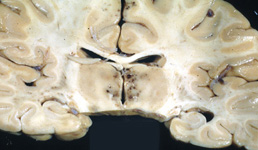
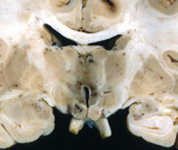
Question 5: A 56 year old man died of gastric carcinoma. The autopsy revealed pathological changes in the brain shown below. The changes are due to:
Incorrect. The pathology (petechiae in the mammillary bodies and around the 3rd ventricle) represents acute Wernicke-Korsakoff syndrome which is caused by Vitamin B1 deficiency.
Correct. The pathology (petechiae in the mammillary bodies and around the 3rd ventricle) represents acute Wernicke-Korsakoff syndrome which is caused by Vitamin B1 deficiency.
Incorrect. The pathology (petechiae in the mammillary bodies and around the 3rd ventricle) represents acute Wernicke-Korsakoff syndrome which is caused by Vitamin B1 deficiency.
Incorrect. The pathology (petechiae in the mammillary bodies and around the 3rd ventricle) represents acute Wernicke-Korsakoff syndrome which is caused by Vitamin B1 deficiency.
Question 6: Wernicke-Korsakoff syndrome is caused by deficiency of:
Correct. Wernicke-Korsakoff syndrome is caused by Vitamin B1 (Thiamine) deficiency, often seen in chronic alcoholism and malnutrition.
Incorrect. Vitamin B12 deficiency causes subacute combined degeneration, not Wernicke-Korsakoff syndrome. WKS is caused by Vitamin B1 (Thiamine) deficiency.
Incorrect. Wernicke-Korsakoff syndrome is caused by Vitamin B1 (Thiamine) deficiency, not B6.
Incorrect. Wernicke-Korsakoff syndrome is caused by Vitamin B1 (Thiamine) deficiency, not folate.
Question 7: Which of the following clinical findings is characteristic of Wernicke encephalopathy (the acute phase of Wernicke-Korsakoff syndrome)?
Correct. The classic triad of Wernicke encephalopathy consists of ophthalmoplegia (eye movement abnormalities), ataxia (loss of balance/coordination), and confusion/altered mental status. This is caused by involvement of the third nerve nucleus, cerebellum/vestibular system, and thalamic/mammillary body involvement.
Incorrect. These findings are characteristic of subacute combined degeneration from Vitamin B12 deficiency. The classic triad of Wernicke encephalopathy is ophthalmoplegia, ataxia, and confusion.
Incorrect. The classic triad of Wernicke encephalopathy is ophthalmoplegia, ataxia, and confusion. Memory impairment (Korsakoff syndrome) develops in the chronic phase.
Incorrect. The classic triad of Wernicke encephalopathy is ophthalmoplegia, ataxia, and confusion, not seizures and focal deficits.
Question 8: A 62 year old chronic alcoholic presents to the emergency department with confusion and difficulty walking. Which vitamin should be administered immediately?
Incorrect. This patient likely has Wernicke encephalopathy and requires immediate Vitamin B1 (Thiamine) administration to prevent permanent brain damage.
Correct. This patient likely has Wernicke encephalopathy from thiamine (Vitamin B1) deficiency, common in chronic alcoholics. Immediate thiamine administration is critical to prevent permanent neurological damage, including Korsakoff syndrome.
Incorrect. While Vitamin B12 is important, this patient likely has Wernicke encephalopathy and requires immediate Vitamin B1 (Thiamine) administration.
Incorrect. This patient likely has Wernicke encephalopathy and requires immediate Vitamin B1 (Thiamine) administration to prevent permanent brain damage.
Question 9: The memory impairment in Korsakoff syndrome (chronic phase of Wernicke-Korsakoff syndrome) primarily affects:
Incorrect. Korsakoff syndrome primarily affects the ability to form new memories (anterograde amnesia), though some retrograde amnesia may also occur. This is due to damage to the mammillary bodies and thalamus, which are important for memory formation.
Incorrect. Korsakoff syndrome primarily affects the ability to form new memories (anterograde amnesia), not just short-term memory. The damage to mammillary bodies and thalamus impairs memory consolidation.
Correct. Korsakoff syndrome is characterized by severe anterograde amnesia (inability to form new memories) and some retrograde amnesia. This is caused by damage to the mammillary bodies and dorsomedial thalamus, which are critical for memory consolidation. Patients may confabulate to fill in memory gaps.
Incorrect. Korsakoff syndrome primarily affects declarative memory (ability to form new memories), not procedural memory. The damage involves mammillary bodies and thalamus.
Question 10: A patient with pernicious anemia is at risk for developing subacute combined degeneration because:
Incorrect. Pernicious anemia results from lack of intrinsic factor, leading to Vitamin B12 malabsorption. B12 deficiency causes subacute combined degeneration through direct metabolic effects on myelin, not through hypoxia.
Correct. Pernicious anemia is caused by autoimmune destruction of gastric parietal cells, leading to lack of intrinsic factor and subsequent Vitamin B12 malabsorption. B12 deficiency causes subacute combined degeneration affecting the dorsal and lateral columns of the spinal cord.
Incorrect. While pernicious anemia has an autoimmune basis, subacute combined degeneration occurs because of Vitamin B12 deficiency resulting from lack of intrinsic factor, not from direct immune attack on myelin.
Incorrect. Pernicious anemia involves Vitamin B12 deficiency, not iron deficiency. B12 deficiency causes subacute combined degeneration of the spinal cord.